How mandatory reporting will drive Qatar’s sustainability agenda
Qatar is the first country in the GCC to mandate ISSB-aligned sustainability disclosure. Here's what IFRS S1 and S2 require, and how they align with Qatar's existing sustainability agenda.
Introduction to IFRS S1 and S2
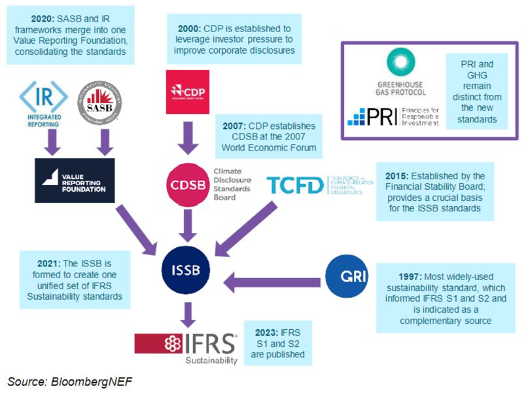
In June 2023, the International Sustainability Standards Board (ISSB) issued its first two global sustainability disclosure standards: IFRS S1 (General Requirements for Disclosure of Sustainability-related Financial Information) and IFRS S2 (Climate-related Disclosures). The ISSB was launched by the IFRS Foundation at COP26, deliberately positioned alongside the International Accounting Standards Board (IASB) to ensure that sustainability reporting would have the same rigour and structure as financial reporting. To build a single coherent framework, the ISSB consolidated four existing sustainability frameworks: the Task Force on Climate-Related Financial Disclosures (TCFD), the Climate Disclosure Standards Board (CDSB) and the Value Reporting Foundation, which had been the home of both the Integrated Reporting Framework and the Sustainability Accounting Standards Board (SASB) Standards (Grant Thornton, 2023). Since the announcement of the unified framework, the standards carry strong backing by major economies, notably the G7, G20, the International Organisation of Securities Commissions (IOSCO) and the Financial Stability Board.
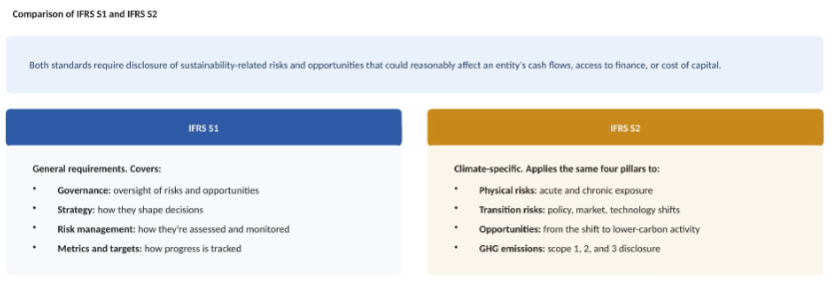
IFRS S1 is the foundational standard for disclosing sustainability-related financial information. It sets the general requirements by obliging companies to disclose material sustainability-related risks and opportunities that could reasonably affect their prospects. Further, S1 requires this information to be presented alongside the financial statements so investors can see the connection between the two. It also requires industry-specific disclosures, drawing on the SASB Standards for guidance on what is relevant to a given sector, and is deliberately GAAP-agnostic, meaning it can be applied alongside IFRS Accounting Standards or other national accounting frameworks.
IFRS S2 builds on that foundation with climate-specific requirements: disclosure of physical and transition risks, scenario analysis showing how different climate outcomes could affect the business, and a set of metrics covering cross-industry measures such as GHG emissions, industry-based metrics and company-specific targets (Grant Thornton, 2023).
Structurally, both IFRS S1 and S2 do not invent something new. They adopt the same four-pillar architecture first established by the TCFD, which the ISSB absorbed when building its own standards:
- Governance: The company’s oversight structure to monitor and manage sustainability-related, and specifically climate-related, risks and opportunities, including the role of the board and senior management.
- Strategy: How identified risks and opportunities actually feed into the company's business model, strategy, and financial planning, including the resilience of that strategy under different climate scenarios.
- Risk Management: The processes used to identify, assess, and manage sustainability-related risks, and how those processes are integrated into the company's overall risk management framework.
- Metrics and Targets: The quantitative measures and targets used to assess and manage material risks and opportunities, from GHG emissions data to progress against stated climate goals.
This continuity from TCFD is deliberate, not incidental. When the ISSB consolidated the standard-setting landscape in 2021–2023, it explicitly built IFRS S2 on the TCFD recommendations rather than starting from scratch. The practical consequence is that any company already reporting against TCFD does not need to rebuild its sustainability reporting architecture from scratch. Many disclosures, including governance structures, risk processes or climate targets, can therefore be mapped directly onto IFRS’ requirements. The key difference with the new standards, however, is the granularity of information and the requirement to sit alongside audited financial statements.
Qatar's Sustainability Agenda
Qatar has moved faster than any other country in the region to adopt IFRS S1 and S2. In 2025, the Qatar Financial Centre Regulatory Authority (QFCRA) finalised rules requiring QFC-regulated entities to report under IFRS S1 and S2, and in December 2025 the Qatar Central Bank (QCB) issued its own Sustainability Reporting Framework for the banks and insurers it regulates. Both took effect on 1 January 2026, making Qatar the first country in the GCC to formally adopt the ISSB standards (S&P Global, 2026; Qatar Tribune, 2025). The Qatar Financial Markets Authority (QFMA) has extended equivalent requirements to Main Market-listed companies under the Governance Code for Listed Companies (QFMA, n.d.). The deadline for publishing the first IFRS S1 and S2 aligned reports is 2027, covering the financial year 2026. Transitional relief applies to certain GHG disclosures in the first two years.
The adoption plan for sustainability disclosure builds on a national agenda that has been developing for close to two decades. The key building block of this agenda is Qatar National Vision 2030 (QNV 2030), a comprehensive framework designed to drive the country's long-term development, built around four interconnected pillars: human development, social development, economic development, and environmental development. Together, these pillars call for a balance between growing the economy and diversifying it, investing in the wellbeing and capabilities of Qatar's people, fostering a cohesive and just society, and protecting and managing the environment for future generations. This holistic vision has been carried forward through Qatar's sequence of National Development Strategies, each translating the four pillars into concrete, time-bound targets and priorities across the relevant sectors.
From 2021 onward, the climate dimension of this agenda sharpened considerably. Qatar's National Climate Change Action Plan, launched that year, set a target of reducing GHG emissions by 25% relative to a business-as-usual scenario by 2030, backed by 36 identified adaptation measures and more than 300 supporting initiatives. The Third National Development Strategy (NDS3, 2024) built directly on this foundation, calling for the scale-up of carbon capture technologies, expanded renewable energy capacity and new energy efficiency measures (Qatar Planning and Statistics Authority, 2024). These commitments are now formalised through Qatar's Nationally Determined Contributions (NDCs), its National Climate Change Action Plan and its Sixth National Communication (NC6) to the UNFCCC.
What mandatory disclosure adds to this picture is accountability. A national agenda built on 36 adaptation measures and 300-plus initiatives is only as credible as the data confirming whether they are actually being delivered, and until now, that data has been reported inconsistently. By requiring every QCB- and QFCRA-regulated entity, and Main Market-listed companies, to disclose climate-related governance, risk, strategy, and metrics on a common basis, IFRS S1 and S2 give regulators, national and international investors, and Qatar's own policymakers a standardised way to track progress against QNV 2030 and the NDCs, rather than relying on voluntary reporting from the institutions that choose to participate. In that sense, the mandate is positioning Qatar as a regional leader: it builds the transparency infrastructure the sustainability agenda needs in order to be verifiably delivered.
Progress to date by Qatari companies
Several Qatari institutions were building sustainability reporting capability well ahead of the mandate, giving the country a base of practical experience to build on:
- Qatar Stock Exchange (QSE) laid the groundwork: it subscribed to the UN Sustainable Stock Exchanges Initiative in 2016, published ESG reporting guidance for listed companies in 2017, and launched its ESG and Sustainability Dashboard in 2018, giving Qatar's roughly 50 listed issuers a voluntary reporting infrastructure years before disclosure became mandatory.
- QNB, Qatar's largest bank, has published TCFD-aligned sustainability reporting since 2018 and issued the region's first-ever green bond in 2020. Its ESG-linked corporate lending grew from 5% of its loan book in 2022 to more than 12% in 2024 (Middle East Briefing, 2025).
- Commercial Bank and Masraf Al Rayan were the other two of Qatar's top five banks that had, as of Q1 2025, already publicly disclosed ESG integration initiatives, including climate risk metrics embedded in lending decisions. Masraf Al Rayan has also stood up a dedicated green finance unit targeting QAR 3 billion, approximately USD 820 million, in sustainable project financing by 2026 (Middle East Briefing, 2025).
- Qatar Financial Centre (QFC) launched the Gulf's first sustainable sukuk and bond regulatory framework in March 2022, a year ahead of the TFSSP itself (Oxford Business Group, 2025b).
- At the sovereign level, Qatar issued its first-ever sovereign green bond in 2025, raising more than USD 2.5 billion at 5.6 times oversubscription, later named “Deal of the Year” at the Global Banking and Markets: Middle East Awards 2025 (ESG News, 2025).
Even so, this progress remains concentrated among the largest and most internationally exposed players. As of April 2025, fewer than 40% of licensed banks in Qatar had established internal ESG governance structures or embedded sustainability-linked lending practices (Middle East Briefing, 2025). That gap is precisely what the 2026 mandate is designed to close: rather than leaving sustainability reporting to a handful of leaders, IFRS S1 and S2 make it a baseline requirement for every regulated institution.
Practical recommendations
Turning the analysis above into practical action, organisations that are required to disclose in alignment with IFRS S1 and S2 should begin preparing now to align with the 2027 deadline. Much of the groundwork can begin now, using resources and data organisations already have in place. Three recommendations stand out as low-hanging fruit: practical steps that organisations can take immediately to build readiness.
- Familiarise yourself with the standards. IFRS S1 and S2, along with the annexed application guidance, are freely available on the IFRS Foundation's website. The language is technical and can be dense on a first read, but working through the standards themselves gives teams a much firmer grasp of what is actually required and reduces the risk of misinterpretation.
- Review financial materiality. Work with risk and finance teams to identify which sustainability-related risks and opportunities could reasonably affect the organisation’s cash flows, financing or cost of capital, using the materiality lens set out in IFRS S1. This is the foundation everything else depends on: getting the assessment right early is what determines whether the rest of the disclosure is complete and credible.
- Secure buy-in across every department. IFRS S1 and S2 reporting draws on data and analysis from finance, governance, risk, treasury, operations, and strategy alike. Building that cross-functional ownership now, rather than leaving it to a single sustainability officer, is what ensures the organisation is genuinely ready when the regulatory deadline arrives, instead of struggling to assemble the report at the last minute.
- Leverage existing frameworks. Few organisations are starting from zero. The ISSB standards were deliberately built to incorporate the recommendations of TCFD and the industry metrics of the SASB. This means that historical TCFD- or SASB-aligned reporting, or even climate and ESG data already collected for other purposes, can be mapped onto IFRS S1 and S2's requirements.
Conclusion
Qatar already has the elements of a credible sustainability journey in place: a long-standing national agenda under QNV 2030, concrete adaptation and emissions targets, and a handful of strong institutions that have proven sustainability reporting and green finance can work in the Qatari market. What has been missing is consistency: most of this progress has, until now, depended on individual institutions choosing to lead rather than being required to follow.
Mandatory IFRS S1 and S2 reporting changes that. By setting a single, comparable disclosure baseline for every QCB- and QFCRA-regulated entity, and for Main Market-listed companies, the mandate takes what QNB, QSE, and QFC have already demonstrated is possible and makes it the expectation for the entire market. Whether Qatar's sustainability journey advances as quickly as its regulatory ambition now depends on how fast the remaining 60% of licensed banks, and the wider corporate sector behind them, can close that gap.
References
ESG News. (2025, August 14). Qatar expands green finance strategy with first sovereign green bonds. https://esgnews.com/qatar-expands-green-finance-strategy-with-first-sovereign-green-bonds/
Grant Thornton International Ltd. (2023, August 9). Overview of IFRS S1 and IFRS S2. https://www.grantthornton.global/en/insights/articles/overview-of-ifrs-s1-and-ifrs-s2/
Middle East Briefing. (2025, April 30). Qatar Central Bank issues Sustainable Finance Framework to align financial sector with ESG goals. https://www.middleeastbriefing.com/news/qatar-central-bank-issues-sustainable-finance-framework/
Oxford Business Group. (2025b). Islamic finance sees rising demand for sustainable debt to meet climate goals in Qatar. Qatar 2025 Report. https://oxfordbusinessgroup.com/reports/qatar/2025-report/islamic-financial-services/
The Peninsula Qatar. (2023, November 28). 3rd Financial Sector Strategy launched. https://thepeninsulaqatar.com/article/28/11/2023/3rd-financial-sector-strategy-launched
Qatar Financial Centre Regulatory Authority (QFCRA). (n.d.). Strategy: Third Financial Sector Strategic Plan. https://www.qfcra.com/strategy/
Qatar Financial Markets Authority (QFMA). (n.d.). Guidance on IFRS S1 and IFRS S2 for listed companies. https://www.qfma.org.qa/English/QSG.pdf
Qatar Planning and Statistics Authority. (2024). Third National Development Strategy 2023–2030 (NDS3). https://www.npc.qa/en/planning/nds3/
Qatar Tribune. (2025, December 5). QCB unveils ISSB-aligned sustainability framework. https://www.qatar-tribune.com/article/207925/business/qcb-unveils-issb-aligned-sustainability-framework/amp
S&P Global Sustainable1. (2026, February 6). ISSB regulatory tracker: January 2026. https://www.spglobal.com/sustainable1/en/insights/regulatory-tracker/issb-january-2026
Sustainable Stock Exchanges Initiative, IFRS Foundation, & International Finance Corporation. (2025). IFRS Sustainability Disclosure Standards S1 and S2 training workshop handout. https://sseinitiative.org/sites/sseinitiative/files/documents/lao-issb-training-handout-5-jun.pdf
Sustainable Stock Exchanges Initiative. (n.d.). IFRS S1 and S2 training video [Video]. YouTube. https://www.youtube.com/watch?v=-ZDXZlJEEhY